# Innovation Pipelines
Definition
The Innovation Pipelines visualizes the connections between research institutions, their research groups, the startups they create, and the larger industries those startups flow into. It shows how innovations flow from academic discovery to entrepreneurial ventures, breaking down startup activities by sector and linking them to established businesses. By illustrating these pathways, the Startup Pipeline highlights the role of institutions in fostering entrepreneurship and accelerating economic growth.
Navigation
This KPI is presented as a Sankey (flow) diagram, structured at the metropolitan level and explorable by Knowledge Area.
There are Three Main Flow Sections:
1. Academia (Left) - representing Universities, Departments, and Research Groups
2. Startups (Middle) - representing businesses, categorized by thematic fields and applied sectors (e.g. Automation, Cloud Computing, E-Commerce)
3. Industry (Right)
1. Industry sectors classified using NAICS codes
2. Represent the final destinations where innovation enters mainstream economic production
Interactivity:
* Hover or click on any node to the number of connections
* Thickness of connections reflects number of linked entities or aggregate revenue/employment
* Sum totals of each vertical are also presented
Methodology
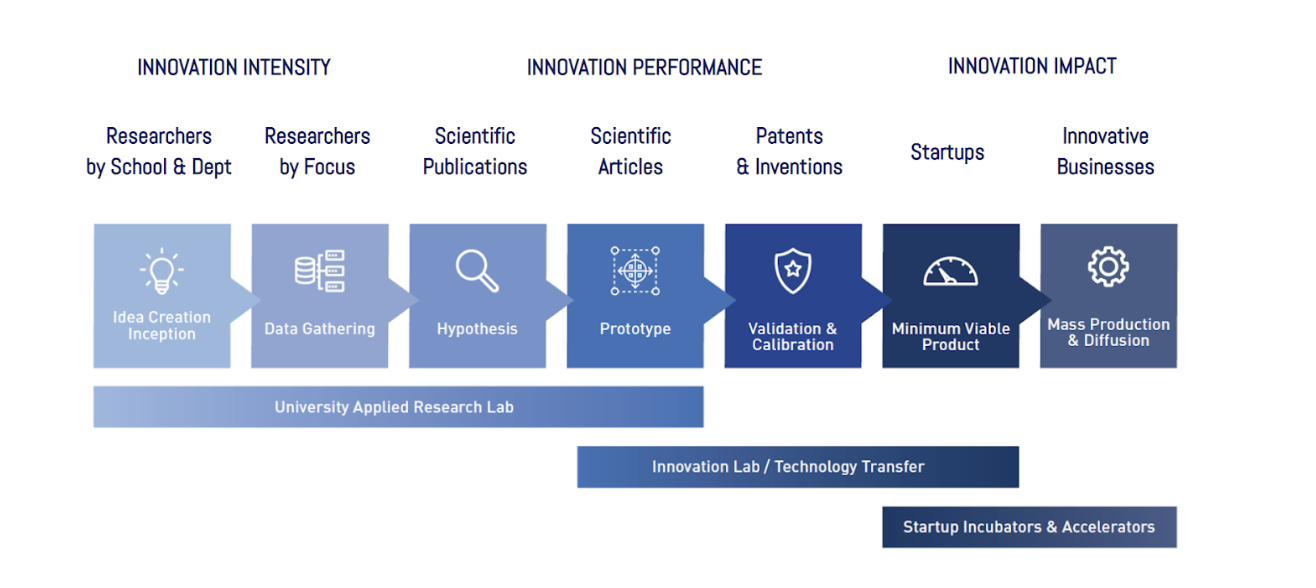
The Innovation Pipeline is structured using a three-layer model mapped to Aretian’s 7 Phases of Innovation:
1. Academia (Idea Creation to Prototypes)
1. Nodes represent real institutions, departments, and research groups
2. Covers phases like: Idea Creation, Data Gathering, Hypothesis, Prototyping
3. Built from research databases and institutional directories
2. Startups (MVPs to Diffusion)
1. Businesses are derived from startup registries, tied to Knowledge Area classification.
2. Represent intermediate phases: Validation & Calibration, MVP development, and early-stage commercialization
3. Categorized by thematic fields and applied domain.
4. Nodes are sized by the number of businesses
3. Industry
1. Endpoints of innovation diffusion, where startups evolve or connect to mature sectors
2. Classified using NAICS codes
3. Nodes are sized by the number of businesses
Thematic Linkages across layers are inferred, using:
* Semantic similarity across Knowledge Areas
* Industry proximity via product/service classification
* Regional clustering patterns
Knowledge Areas are derived from interdisciplinary clustering of academic research, startup activity, and technology applications and are defined as the following:
| Knowledge Area | Description |
| --------------------------------- | --------------------------------------------------------------------------------------------------------------------------- |
| Advanced Manufacturing | Innovations in robotics, automation, precision engineering, and new materials driving industrial production. |
| Agricultural Technology | Developments in precision farming, climate-resilient crops, food security, and sustainable agricultural systems |
| Artificial Intelligence | Applications of machine learning, automation, data science, and AI-driven decision-making across industries. |
| Digital Culture & Social Sciences | Research at the intersection of digital media, behavioral analytics, human-computer interaction, and urban studies. |
| Digital Design | Advances in computational design, generative modeling, AR/VR, and digital fabrication techniques. |
| Emerging Technologies | Breakthroughs in quantum computing, blockchain, bioinformatics, and next-generation computing systems. |
| Energy & Sustainability (E\&S) | Innovations in renewable energy, smart grids, circular economy solutions, and climate technologies |
| Medical & Bio | Cutting-edge developments in biotechnology, medical devices, health diagnostics, and bioinformatics. |
| Nanotechnology | Research in nanoscale materials, molecular engineering, and high-performance applications across industries. |
| Pharma and Cosmetics | Advancements in pharmaceutical R\&D, biopharma, drug discovery, and cosmetic science. |
| UrbanTech | Technologies focused on construction, real estate, smart buildings, sustainable housing, and built environment innovations. |
Calculation
This KPI is non-numeric and serves as a structural diagnostic tool.
However, flows are sized based on available quantitative indicators, such as:
* Confirmed entity counts (e.g. startups per group)
* Revenue or IP weighting (if available)
Interpretation
The Innovation Pipeline reveals how regional innovation ecosystems operate and where they may be strengthened:
* Strong flows from academia to startups = effective tech transfer systems
* Diverse flows to industry = broad applicability and sectoral resilience
* Gaps or bottlenecks between phases = potential targets for investment, incubation, or institutional support
It helps identify:
* Anchor research groups and potential spin-off engines
* Sectors with latent potential for innovation
* Strategic intersections where academia and industry need to align better